For families with significant wealth, giving is about more than reducing estate taxes. It is also about deciding what the family wants its wealth to accomplish, preparing the next generation for responsibility and creating a clear way to make decisions together.
Many families allow taxes to drive their giving and gifting conversations, but the best plan is to focus on the larger legacy and charitable goals and develop a strategy that brings together charitable giving, gifts to children and future generations, and governance of the assets. Focusing too much on taxes, and not enough on the family and human elements of a plan can cause undesirable outcomes.
When we do not place enough emphasis on the why, and instead the how, there can be unintended consequences:
- Giving away too much, too early. Families may move significant wealth into irrevocable trusts simply because exemption is available, then later realize they gave up more flexibility or access than they were comfortable with.
- Loss of control. Tax-efficient structures often require someone else to serve as trustee, manager, or decision-maker. A family can end up with a structure that saves tax but feels restrictive.
- Poor liquidity. Assets may be moved into trusts or entities without enough thought about who will actually have cash available for lifestyle needs, taxes, insurance premiums, property expenses, or future opportunities.
- Creating complexity that lasts for generations. Multiple trusts, LLCs, partnerships, committees, and special powers can create administrative burdens, legal fees, accounting costs, and confusion that eventually outweigh some of the tax savings.
- Family conflict. A tax-driven plan may treat beneficiaries differently because of technical considerations rather than family considerations. Children may perceive unequal access, control, or opportunity leading to family conflict.
- Making the next generation dependent rather than prepared. If the focus is entirely on protecting and transferring wealth, families can miss the opportunity to teach children how to manage money, make decisions, understand risk, and participate in family governance.
The goal is to preserve the family’s flexibility, opportunity and wealth while still being thoughtful about taxes. Tax planning matters, but it should support the family’s broader objectives rather than define them.
That leads to a more important set of questions: What do we want our wealth to accomplish? What values do we want to reinforce? And how do we want future generations to participate?
Family Giving: What Matters to Us?
Philanthropy can be a useful way for different generations to work together and put family values into action. Giving can be done in an ad hoc manner, or in a very organized and thoughtful way. There is no one-size-fits-all solution to giving, so families need to find what works for them.
Ways to Give:
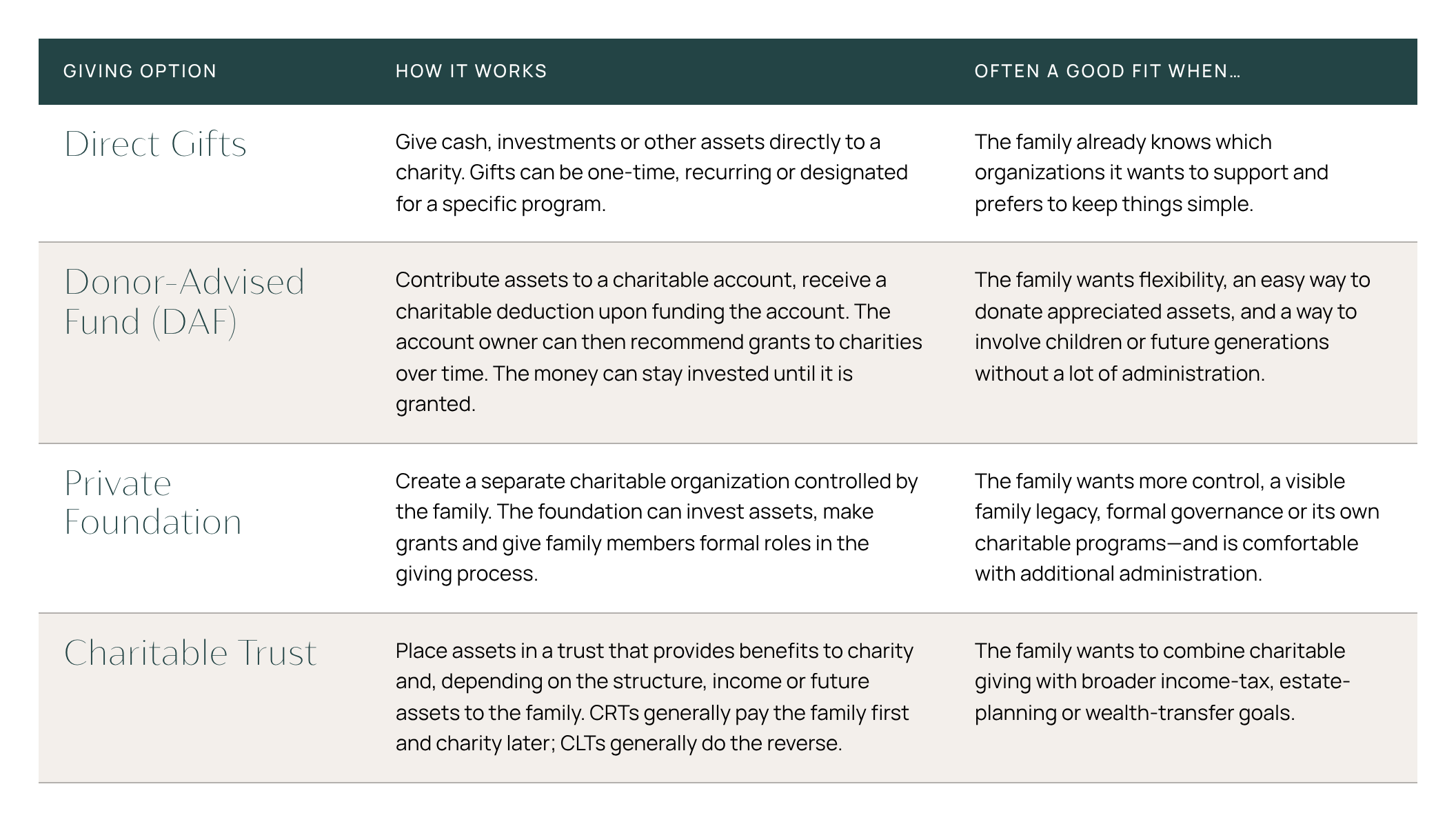
Gifting highly appreciated assets or retirement assets (either at passing or through qualified charitable distributions- QCDs) is the most tax-efficient way to give. Depending on the entity receiving the asset, and the assets given, the deductions have certain limit against AGI. In all situations, unused deductions for charitable giving can be carried-forward up to 5 tax years.
If a business sale or other liquidity event is anticipated, begin planning early. A charitable gift completed before the sale becomes legally binding may avoid capital gains tax on the donated portion and generate a charitable deduction. Waiting too long may raise assignment-of-income concerns. Closely held business interests require formal valuations, and the available deduction may depend on both the asset and the recipient organization. For example, donating an interest in a closely held business to a private foundation may limit the deduction to the donor’s tax basis rather than fair market value. Work with your tax, legal, and financial advisors to determine the appropriate gifting strategy.
Gifting to Family: What Legacy Do We Want to Leave?
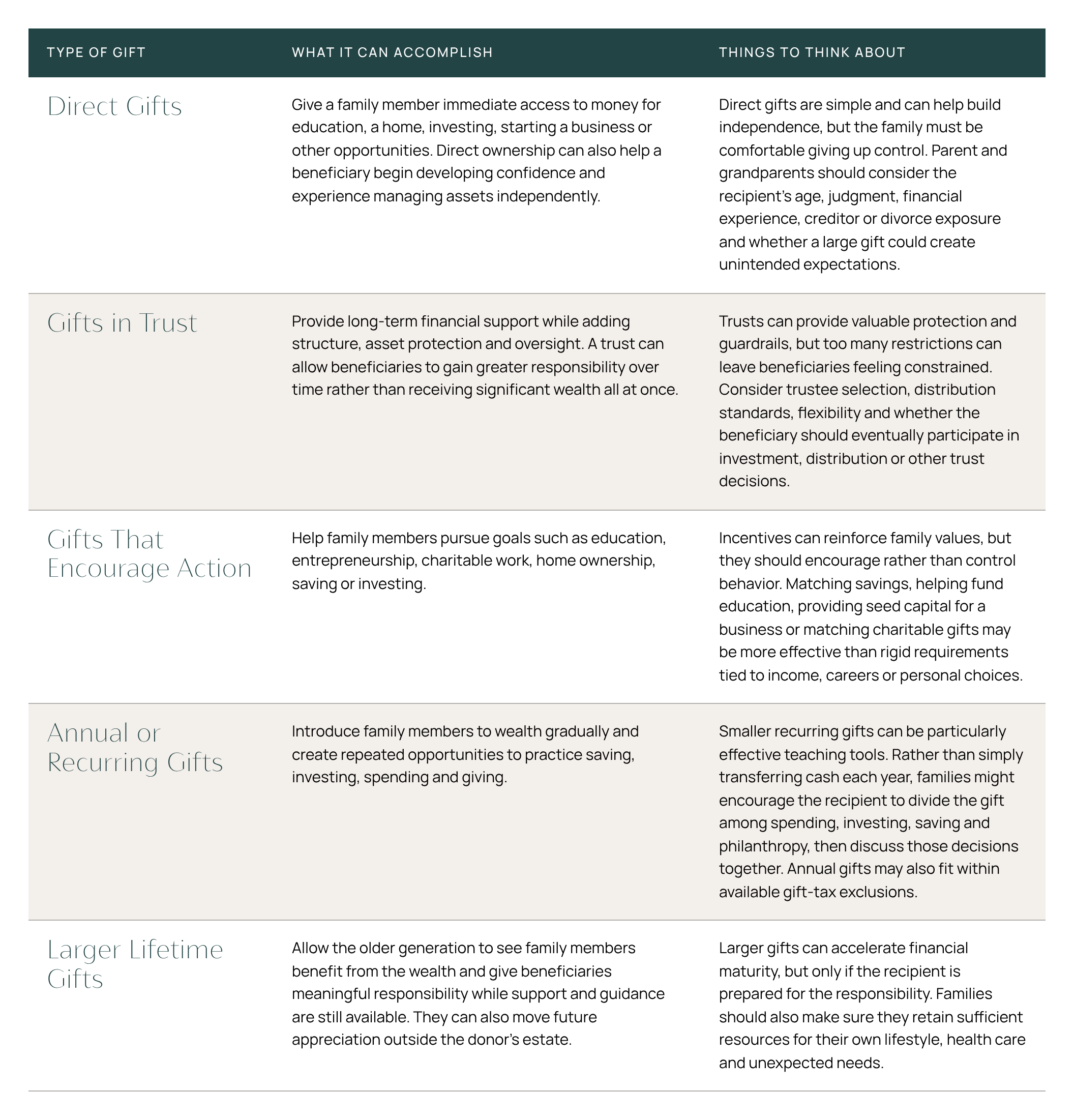
For many families, gifting is about much more than reducing estate taxes or moving assets to the next generation. Done thoughtfully, gifting can be an important part of preparing children and grandchildren to manage wealth responsibly.
Lifetime gifts can give family members the opportunity to make financial decisions while parents or grandparents are still available to provide guidance. Rather than receiving a large inheritance all at once later in life, beneficiaries can gradually gain experience with saving, investing, budgeting, philanthropy and making thoughtful decisions about wealth.
Gifting can also help families share values, support important life goals, create opportunities and encourage independence. Depending on how gifts are structured, they may help a child purchase a first home, pursue education, start a business, build an investment portfolio or become involved in charitable giving.
Perhaps more importantly, gifting can create opportunities for conversations about money that might otherwise never occur. Families can use gifts to discuss how wealth was created, what responsibilities come with it, how investment decisions are made and what the family hopes its wealth will accomplish over time.
Before deciding how much to give or which strategy to use, it can be helpful to start with a few broader questions:
- What does the family want this wealth to make possible?
- What financial skills or behaviors does the family hope to encourage?
- How much independence should each generation have?
- Are there opportunities to involve children in investing, philanthropy or family financial decisions before transferring significant wealth?
- How can gifts support family members without creating dependency or an expectation that financial support will always be available?
- Should responsibility increase gradually as a beneficiary demonstrates financial maturity?
Things to Think About When Gifting to Family
Gifting tends to work best when the structure of the gift matches the family’s values and the purpose behind it. Tax and legal considerations still matter, but they should support the family’s goals rather than drive the entire decision.
As families become more intentional about gifting, philanthropy and preparing the next generation, the conversation often expands beyond individual transfers to a broader question: how will the family make decisions together over time? Decisions about how much to give, what opportunities to support, which charitable causes matter most and what kind of legacy the family wants to create are rarely isolated issues. They are all part of the same larger conversation about purpose, responsibility and stewardship.
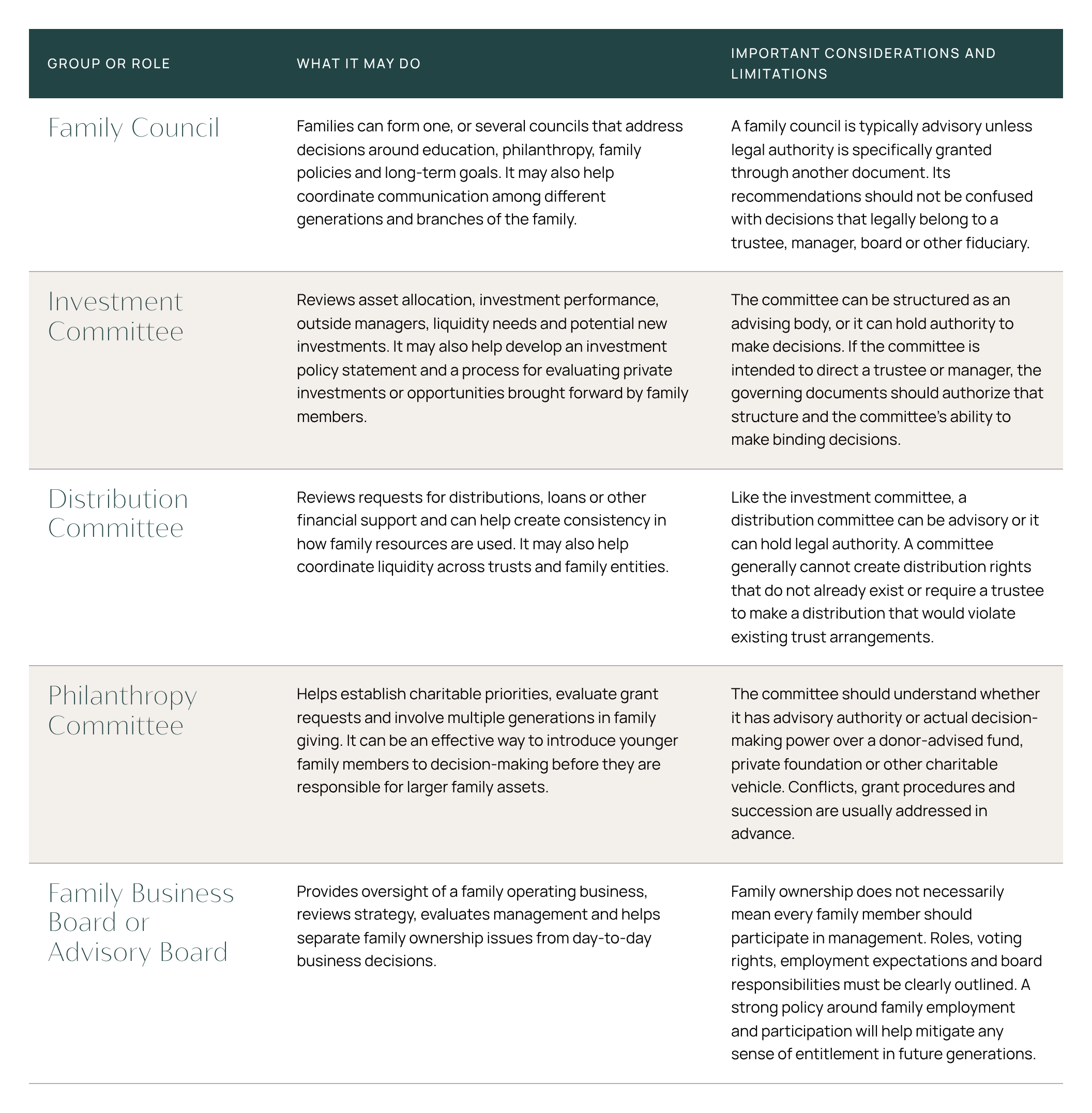
This is where family governance can become valuable. A governance structure does not have to be overly formal or complicated. For some families the idea of family governance is simply to create a consistent way for family members to communicate, make decisions, educate the next generation and revisit shared priorities as circumstances change. For some families, that may mean regular family meetings. For others, it may include an investment committee, a philanthropy committee, a family council or written guidelines around distributions, charitable giving and decision-making.
Family Governance Around Shared Assets
Governance is simply the framework a family uses to make decisions, assign responsibility, communicate expectations and work through disagreements. For families with significant wealth, governance can help bring more consistency to decisions, especially as the generations grow.
Good governance does not mean that every family decision needs to become formal. In many cases, the goal is simply to create enough structure that everyone understands who is involved, how decisions are made and what happens when family members disagree. Not every decision can be made by consulting each and every family member. Governance allows those family members with specific knowledge, interest and background to focus on the areas special to them, while allowing other family members to address different concerns.
It must noted however, that consensus and legal authority are not the same thing. A family council or committee may discuss an issue and make a recommendation, while the trustee, LLC manager, board of directors or other fiduciary may still be the person legally responsible for making the final decision.
Clarify Who Decides What
One of the most important parts of family governance is distinguishing between who is involved in the discussion, who can make a formal recommendation, and finally who has authority to implement that recommendation.
For example, a family investment committee may agree that the family should invest in a new private business. That may be a valuable recommendation, but the trustee of a trust or manager of an LLC may still need to determine whether the investment is appropriate for the assets under that person's control.
Similarly, a distribution committee may recommend helping a beneficiary purchase a home, but the trustee still needs to determine whether the requested distribution is permitted under the trust agreement and consistent with the trustee's fiduciary responsibilities. A recommendation that is inconsistent with the trust document cannot be enforced.
A clear governance structure should therefore answer questions such as:
- Who is responsible for gathering information?
- Who participates in the discussion?
- Who makes recommendations?
- Who has authority to make the final decision?
- What vote or level of consensus is required?
- What happens if the committee is divided?
- How are conflicts of interest handled?
Not every family is going to implement a governance structure, but for families with substantial assets, giving, gifting and family governance should all be viewed as one coordinated plan. Charitable giving provides an opportunity to teach younger generations about family values and purpose. It can also be an entry point to financial education and decision-making.
Having exposure to charitable giving and managing charitable assets also serves to prepare family members for receiving their own gifts and managing their own trusts. When considering larger family gifts, there should also be a framework for managing those assets and making decisions.
When starting to formalize any giving, gifting or governance plan, the main priority is aligning the family around shared values and expectations. Roles must be clear, and there needs to be room for meaningful participation for all family members that meet these expectations. It is also important to be flexible. Circumstances and priorities may change, but a strong governance structure paired with a shared vision can create a long-lasting family legacy.
Sapient Capital, LLC (“Sapient Capital”) is a registered investment advisor. Advisory services are only offered to clients or prospective clients where Sapient Capital and its representatives are properly licensed or exempt from licensure. The information provided is for educational and informational purposes only and does not constitute investment, estate planning, insurance, or tax advice, and should not be relied on as such. It does not take into account any investor’s current estate plan, financial needs, insurance needs, investment objectives, strategies, tax status, or investment horizon. You should consult your attorney or tax advisor. Additional disclosures are available at sapientcapital.com and on our ADV Part 2A.This material may have been generated with the help of and/or reviewed by artificial intelligence software tools. Sapient Capital has reviewed and approved all content to ensure accuracy and compliance with applicable regulatory requirements. While Sapient Capital reviews such content for accuracy and compliance, artificial intelligence tools may produce incomplete or inaccurate information. Accordingly, Sapient Capital does not guarantee the accuracy or completeness of information generated by such tools.